
Cold Turkey
By Kurt Vonnegut
Many years ago, I was so innocent I still considered it possible that we could become the humane and reasonable America so many members of my generation used to dream of. We dreamed of such an America during the Great Depression, when there were no jobs. And then we fought and often died for that dream during the Second World War, when there was no peace.
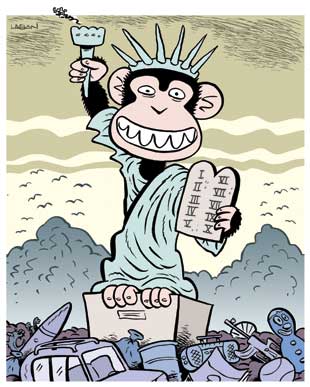
But I know now that there is not a chance in hell of America’s becoming humane and reasonable. Because power corrupts us, and absolute power corrupts absolutely. Human beings are chimpanzees who get crazy drunk on power. By saying that our leaders are power-drunk chimpanzees, am I in danger of wrecking the morale of our soldiers fighting and dying in the Middle East? Their morale, like so many bodies, is already shot to pieces. They are being treated, as I never was, like toys a rich kid got for Christmas.
————————————-
When you get to my age, if you get to my age, which is 81, and if you have reproduced, you will find yourself asking your own children, who are themselves middle-aged, what life is all about. I have seven kids, four of them adopted.
Many of you reading this are probably the same age as my grandchildren. They, like you, are being royally shafted and lied to by our Baby Boomer corporations and government.
I put my big question about life to my biological son Mark. Mark is a pediatrician, and author of a memoir, The Eden Express. It is about his crackup, straightjacket and padded cell stuff, from which he recovered sufficiently to graduate from Harvard Medical School.
Dr. Vonnegut said this to his doddering old dad: “Father, we are here to help each other get through this thing, whatever it is.” So I pass that on to you. Write it down, and put it in your computer, so you can forget it.
I have to say that’s a pretty good sound bite, almost as good as, “Do unto others as you would have them do unto you.” A lot of people think Jesus said that, because it is so much the sort of thing Jesus liked to say. But it was actually said by Confucius, a Chinese philosopher, 500 years before there was that greatest and most humane of human beings, named Jesus Christ.
The Chinese also gave us, via Marco Polo, pasta and the formula for gunpowder. The Chinese were so dumb they only used gunpowder for fireworks. And everybody was so dumb back then that nobody in either hemisphere even knew that there was another one.
But back to people, like Confucius and Jesus and my son the doctor, Mark, who’ve said how we could behave more humanely, and maybe make the world a less painful place. One of my favorites is Eugene Debs, from Terre Haute in my native state of Indiana. Get a load of this:
Eugene Debs, who died back in 1926, when I was only 4, ran 5 times as the Socialist Party candidate for president, winning 900,000 votes, 6 percent of the popular vote, in 1912, if you can imagine such a ballot. He had this to say while campaigning:
As long as there is a lower class, I am in it.
As long as there is a criminal element, I’m of it.
As long as there is a soul in prison, I am not free.Doesn’t anything socialistic make you want to throw up? Like great public schools or health insurance for all?
How about Jesus’ Sermon on the Mount, the Beatitudes?
Blessed are the meek, for they shall inherit the Earth.
Blessed are the merciful, for they shall obtain mercy.
Blessed are the peacemakers, for they shall be called the children of God. …
And so on.
Not exactly planks in a Republican platform. Not exactly Donald Rumsfeld or Dick Cheney stuff.
For some reason, the most vocal Christians among us never mention the Beatitudes. But, often with tears in their eyes, they demand that the Ten Commandments be posted in public buildings. And of course that’s Moses, not Jesus. I haven’t heard one of them demand that the Sermon on the Mount, the Beatitudes, be posted anywhere.
“Blessed are the merciful” in a courtroom? “Blessed are the peacemakers” in the Pentagon? Give me a break!
————————————-
There is a tragic flaw in our precious Constitution, and I don’t know what can be done to fix it. This is it: Only nut cases want to be president.
But, when you stop to think about it, only a nut case would want to be a human being, if he or she had a choice. Such treacherous, untrustworthy, lying and greedy animals we are!
I was born a human being in 1922 A.D. What does “A.D.” signify? That commemorates an inmate of this lunatic asylum we call Earth who was nailed to a wooden cross by a bunch of other inmates. With him still conscious, they hammered spikes through his wrists and insteps, and into the wood. Then they set the cross upright, so he dangled up there where even the shortest person in the crowd could see him writhing this way and that.
Can you imagine people doing such a thing to a person?
No problem. That’s entertainment. Ask the devout Roman Catholic Mel Gibson, who, as an act of piety, has just made a fortune with a movie about how Jesus was tortured. Never mind what Jesus said.
During the reign of King Henry the Eighth, founder of the Church of England, he had a counterfeiter boiled alive in public. Show biz again.
Mel Gibson’s next movie should be The Counterfeiter. Box office records will again be broken.
One of the few good things about modern times: If you die horribly on television, you will not have died in vain. You will have entertained us.
————————————-
And what did the great British historian Edward Gibbon, 1737-1794 A.D., have to say about the human record so far? He said, “History is indeed little more than the register of the crimes, follies and misfortunes of mankind.”
The same can be said about this morning’s edition of the New York Times.
The French-Algerian writer Albert Camus, who won a Nobel Prize for Literature in 1957, wrote, “There is but one truly serious philosophical problem, and that is suicide.”
So there’s another barrel of laughs from literature. Camus died in an automobile accident. His dates? 1913-1960 A.D.
Listen. All great literature is about what a bummer it is to be a human being: Moby Dick, Huckleberry Finn, The Red Badge of Courage, the Iliad and the Odyssey, Crime and Punishment, the Bible and The Charge of the Light Brigade.
But I have to say this in defense of humankind: No matter in what era in history, including the Garden of Eden, everybody just got there. And, except for the Garden of Eden, there were already all these crazy games going on, which could make you act crazy, even if you weren’t crazy to begin with. Some of the games that were already going on when you got here were love and hate, liberalism and conservatism, automobiles and credit cards, golf and girls’ basketball.
Even crazier than golf, though, is modern American politics, where, thanks to TV and for the convenience of TV, you can only be one of two kinds of human beings, either a liberal or a conservative.
Actually, this same sort of thing happened to the people of England generations ago, and Sir William Gilbert, of the radical team of Gilbert and Sullivan, wrote these words for a song about it back then:
I often think it’s comical
How nature always does contrive
That every boy and every gal
That’s born into the world alive
Is either a little Liberal
Or else a little Conservative.Which one are you in this country? It’s practically a law of life that you have to be one or the other? If you aren’t one or the other, you might as well be a doughnut.
If some of you still haven’t decided, I’ll make it easy for you.
If you want to take my guns away from me, and you’re all for murdering fetuses, and love it when homosexuals marry each other, and want to give them kitchen appliances at their showers, and you’re for the poor, you’re a liberal.
If you are against those perversions and for the rich, you’re a conservative.
What could be simpler?
————————————-
My government’s got a war on drugs. But get this: The two most widely abused and addictive and destructive of all substances are both perfectly legal.
One, of course, is ethyl alcohol. And President George W. Bush, no less, and by his own admission, was smashed or tiddley-poo or four sheets to the wind a good deal of the time from when he was 16 until he was 41. When he was 41, he says, Jesus appeared to him and made him knock off the sauce, stop gargling nose paint.
Other drunks have seen pink elephants.
And do you know why I think he is so pissed off at Arabs? They invented algebra. Arabs also invented the numbers we use, including a symbol for nothing, which nobody else had ever had before. You think Arabs are dumb? Try doing long division with Roman numerals.
We’re spreading democracy, are we? Same way European explorers brought Christianity to the Indians, what we now call “Native Americans.”
How ungrateful they were! How ungrateful are the people of Baghdad today.
So let’s give another big tax cut to the super-rich. That’ll teach bin Laden a lesson he won’t soon forget. Hail to the Chief.
That chief and his cohorts have as little to do with Democracy as the Europeans had to do with Christianity. We the people have absolutely no say in whatever they choose to do next. In case you haven’t noticed, they’ve already cleaned out the treasury, passing it out to pals in the war and national security rackets, leaving your generation and the next one with a perfectly enormous debt that you’ll be asked to repay.
Nobody let out a peep when they did that to you, because they have disconnected every burglar alarm in the Constitution: The House, the Senate, the Supreme Court, the FBI, the free press (which, having been embedded, has forsaken the First Amendment) and We the People.
About my own history of foreign substance abuse. I’ve been a coward about heroin and cocaine and LSD and so on, afraid they might put me over the edge. I did smoke a joint of marijuana one time with Jerry Garcia and the Grateful Dead, just to be sociable. It didn’t seem to do anything to me, one way or the other, so I never did it again. And by the grace of God, or whatever, I am not an alcoholic, largely a matter of genes. I take a couple of drinks now and then, and will do it again tonight. But two is my limit. No problem.
I am of course notoriously hooked on cigarettes. I keep hoping the things will kill me. A fire at one end and a fool at the other.
But I’ll tell you one thing: I once had a high that not even crack cocaine could match. That was when I got my first driver’s license! Look out, world, here comes Kurt Vonnegut.
And my car back then, a Studebaker, as I recall, was powered, as are almost all means of transportation and other machinery today, and electric power plants and furnaces, by the most abused and addictive and destructive drugs of all: fossil fuels.
When you got here, even when I got here, the industrialized world was already hopelessly hooked on fossil fuels, and very soon now there won’t be any more of those. Cold turkey.
Can I tell you the truth? I mean this isn’t like TV news, is it?
Here’s what I think the truth is: We are all addicts of fossil fuels in a state of denial, about to face cold turkey.
And like so many addicts about to face cold turkey, our leaders are now committing violent crimes to get what little is left of what we’re hooked on.
Kurt Vonnegut is a legendary author, WWII veteran, humanist, artist, smoker and In These Times senior editor. His classic works include Slaughterhouse-Five, Breakfast of Champions, Cat's Cradle, among many others. His most recent book, A Man Without a Country, collects many of the articles written for this magazine.
Showing posts with label literature. Show all posts
Showing posts with label literature. Show all posts
Wednesday, August 20, 2008
Kurt
Some day, when I'm old and all out of compassion I hope to be able to ramble like Mr. V:

Wednesday, March 19, 2008
Science Fiction!!!! - 1
Arthur Clarke is dead. He was 90 and lived in Sri Lanka. He wrote a few fantastic science fiction books. I don't know what he'd been doing recently though, except for suffer from respiratory problems.
Wednesday, December 5, 2007
What to do when something is wrong in your community
I'm one of those idealists that believes that the best way to go about social change is to educate the general public. Most people are just not aware of the bad things going on around them, and even if they are, they often feel helpless OR they believe such is the natural state of things and should not be interfered with. So educating someone isn't just about exposing the problem, but also about providing evidence that it doesn't have to be that way and it's worth putting forth the effort to change something.
The problem is that getting through to the average 30 year old, or a 40 year old, or a 50 year old is really really hard. I've tried and failed, and I've seen people more clever than myself try and fail. (The problem, if you care to hear my opinion, is that, while they are quick to feel the offense, they are even quicker to forget and go back to the status quo using the "I can't do anything about it" excuse to make themselves feel less culpable -- something which I know I am often guilty of doing myself).
So we have to educate young people.
Websites like "the story of stuff" are doing that and I commend them for it.
As I watched their presentation I felt that they were being a bit alarmist. Being a middle of the road sort of person, I often filter arguments to simple emotionless cores. But recently I've realized that even if the situation is not dire, people need to feel that the sky is falling in order to get their ass involved.
My epiphany? I now, finally, learned what that fable is really all about. I know that the story sometimes changes to have a more interpretable moral but here is my take.
Chicken little notices a problem. She is, of course, mistaken. The reader knows it's not really a problem, but she's determined to do right so she goes to the government. Along the way, she meets lots of characters, and each of them is alarmed by her story, but only temporarily. Like adults, they soon forget about the real problem and are swayed off course and promptly eaten by the fox. But Chicken little is singular minded and progresses on to the King who ultimately shows her the error of her ways. But she wasn't eaten by the fox... which is a good thing. She followed her goal to completion, even though it was based on faulty assumptions.
I would rewrite the ending. In my version, shortly after the King explains it all, setting chicken little straight, the acorn tree falls onto the chicken coop killing everyone inside. Because I love irony. And gore.
The problem is that getting through to the average 30 year old, or a 40 year old, or a 50 year old is really really hard. I've tried and failed, and I've seen people more clever than myself try and fail. (The problem, if you care to hear my opinion, is that, while they are quick to feel the offense, they are even quicker to forget and go back to the status quo using the "I can't do anything about it" excuse to make themselves feel less culpable -- something which I know I am often guilty of doing myself).
So we have to educate young people.
Websites like "the story of stuff" are doing that and I commend them for it.
As I watched their presentation I felt that they were being a bit alarmist. Being a middle of the road sort of person, I often filter arguments to simple emotionless cores. But recently I've realized that even if the situation is not dire, people need to feel that the sky is falling in order to get their ass involved.
My epiphany? I now, finally, learned what that fable is really all about. I know that the story sometimes changes to have a more interpretable moral but here is my take.
Chicken little notices a problem. She is, of course, mistaken. The reader knows it's not really a problem, but she's determined to do right so she goes to the government. Along the way, she meets lots of characters, and each of them is alarmed by her story, but only temporarily. Like adults, they soon forget about the real problem and are swayed off course and promptly eaten by the fox. But Chicken little is singular minded and progresses on to the King who ultimately shows her the error of her ways. But she wasn't eaten by the fox... which is a good thing. She followed her goal to completion, even though it was based on faulty assumptions.
I would rewrite the ending. In my version, shortly after the King explains it all, setting chicken little straight, the acorn tree falls onto the chicken coop killing everyone inside. Because I love irony. And gore.
Monday, October 1, 2007
Thursday, June 7, 2007
Part 3 of the "cultural games I don't want to participate in" series
Intellectual Masturbation
I vaguely recall reading Ray Bradbury's Fahrenheit 451 when I was a high school lad. I vaguely remember one of the themes of the book was about government censorship. That's actually a lie. I remember government censorship being the CENTRAL THEME of the book. I don't know if I came up with that analysis or if it was implanted by whichever high school lit teacher was responsible with enlightening me.
The point is that the Author, one Mr. Bradbury, did not intend for that to be THE or even a theme of his book.
Should this matter? After all, the muse works in mysterious ways. Maybe his subconscious was speaking through his pen. Maybe critical analysts of literature are much more intelligent than the authors of the books they critique. Or, maybe, Cien años de soledad was really just about a family and their crazy adventures and not a socio-political allegory on the state of Latin America.
This sort of pseudo-intellectual bullshit is exactly what is supposed to shame me out of reading science fiction. I refuse to buy into it. If you're going to write a book that only a subset of the educated elite population is going to appreciate that's you're prerogative. But I loathe the industry that develops around this very notion that there are different kinds of Art, each belonging to a segregated social class.
We're living in a country where a trip to a MoMA (any of the dozens splayed across the country) is going to cost you $20+ and nobody, not the poor nor the rich, cares. How lucky we are that 3/4th of our population is functionally literate, it's just a shame that less than a fifth of us cares to use that skill.
I'm going to teach my children to read ASAP and then, when they're old enough, I'll give them a copy of Ray Bradbury's "Fahrenheit 451" and then ask them to teach me what it's about. They'll tell me, and then we'll go to an art museum together.
I vaguely recall reading Ray Bradbury's Fahrenheit 451 when I was a high school lad. I vaguely remember one of the themes of the book was about government censorship. That's actually a lie. I remember government censorship being the CENTRAL THEME of the book. I don't know if I came up with that analysis or if it was implanted by whichever high school lit teacher was responsible with enlightening me.
The point is that the Author, one Mr. Bradbury, did not intend for that to be THE or even a theme of his book.
Should this matter? After all, the muse works in mysterious ways. Maybe his subconscious was speaking through his pen. Maybe critical analysts of literature are much more intelligent than the authors of the books they critique. Or, maybe, Cien años de soledad was really just about a family and their crazy adventures and not a socio-political allegory on the state of Latin America.
This sort of pseudo-intellectual bullshit is exactly what is supposed to shame me out of reading science fiction. I refuse to buy into it. If you're going to write a book that only a subset of the educated elite population is going to appreciate that's you're prerogative. But I loathe the industry that develops around this very notion that there are different kinds of Art, each belonging to a segregated social class.
We're living in a country where a trip to a MoMA (any of the dozens splayed across the country) is going to cost you $20+ and nobody, not the poor nor the rich, cares. How lucky we are that 3/4th of our population is functionally literate, it's just a shame that less than a fifth of us cares to use that skill.
I'm going to teach my children to read ASAP and then, when they're old enough, I'll give them a copy of Ray Bradbury's "Fahrenheit 451" and then ask them to teach me what it's about. They'll tell me, and then we'll go to an art museum together.
Tuesday, May 29, 2007
I'm probably on the 6th level
For those who don't know, here are the levels (or circles) of hell according to Dante:
First, you need to go through a dark forest. Here there are animals which can kill you. That's to make sure that living people don't get to hell. Here, you are also likely to find loved ones from heaven who want to make sure that you don't get stuck in hell. They will provide you with a poet, probably a humanist, who will be your guide to hell.
After the woods, you get to the vestibule. This is where you go if you believed in God but didn't take sides. You were neither good nor evil, an opportunist? Then you don't quite go to hell, but you go to the vestibule. Your afterlife in the vestibule is spent chasing an unreachable flag whilst being chased by insects.
Eventually, you reach Charon the boatdude. He takes you across some river where you enter the official first circle of hell. This isn't really hell as we know it, but is more often referred to as Purgatory. This is for unbaptized babies and pre-old testament folks who were pure at heart but weren't given the choice to repent for the sins of their ancestors. Nothing too bad happens here, it's just a basically boring place.
The next circle of hell is where all the lustful go: Romeo and Juliet, Zeus, Magic Johnson. Here, from what I understand, it's very windy. And there's no one to comfort you. So far hell is not that horrible.
In the third level you got your fatties. These are the gluttons who ate and drank of God's gifts and gave nothing but garbage in return. Here there's a lot of filth and garbage, with intermittent freezing rain. Sounds like a winter in New Jersey. However things can get pretty nasty in this circle as the three headed dog Cerberus might chew you to pieces if he gets a hold of you. Things are starting to get a bit more hell like.
Next, you'll get to meet some misers. In the fourth level is where you go if you are rich and collected a lot of wealth but did not give back to the community. These are the hoarders. But they aren't alone. Here you also find wasters. These are people who were given a lot but lost it all in foolish persuits. Some presidents of the US will find themselves here some day (it would seem). Their punishment is to be pushed down by great weights...
That brings us to the level of wrath. If you can't control your temper in life, you end up here, wading through the swampy mire of Styx, endlessly fighting with your neighbors. Every once in a while, you'll trod on a miserly hermit.
The sixth circle is reserved for those who were surrounded by the word of the lord but failed to accept it. These foolish beasts will be living in the capital of hell. Supposedly, this is the turning point too. From this level on things get really bad. Here you'll find Medusa and winged furies. The air is really smelly too, makes you dizzy. But the Heretics are stuck in tombs which are set ablaze. Since they denied God and did not believe in an afterlife, they will now be stuck for eternity in a flaming grave. However, the graves are open so the heretics can go out for a nice walk anytime they want. However, once the rapture is in progress, the lids will clamp down, trapping these heathens forever. If I were there, I'd get out of my firey hole and go find medusa. Spending eternity as a statue in a stinky capital is much better than spending it in a broiling grave.
The seventh circle is actually made up of three sub-circles. This is where the violent people go. If you were violent against others, started wars or beat up neighbors, you get to go under a boiling hot river of blood. If you try to peek out, people shot you with arrows and stab you with spears. If you were violent against yourself, that is you cut yourself or kill yourself, you are turned into a tree. It is upon this tree that harpies eat and I guess it hurts because you'll bleed and scream every time the harpies take a bite. You do this forever because you are growing quite fast, as fast as you are being eaten I presume. If you were violent against God, this includes sodomites, blasphemers, and art critics (I'm not making this up) then you get to spend eternity in a desert showered upon by fire rain.
Those last two levels were pretty bad, I guess. I think that a 21st century author could have come up with much worse punishments than those. Read Harlan Ellison for an example.
The second to last level is very tough to describe. That's basically because it's like 10 levels in one. I think Dante was a bit strapped here trying to include a bunch of other sinners without including another dozen levels. So he hodge podged 10 groups in this one circle.
Who gets to go here?
1) Thieves
2) Hypocrites
3) Panderers
4) People who exchange a high position in the church for money
5) Flatterers
6) Liars
7) Pessimists who are loud about it
8) Evil counselors
9) Fortune tellers
10) ?
The 10th are referred to as grafters, but I don't know what a grafter is. Best as I can tell, a grafter is a greedy person, but I thought those people are already spending time on the 5th level so I'm confused.
Anyway, all these people are given punishments that fit the crime, but they are all pretty dull. So I wasn't very surprised at the disappointment of the last, most evil level of hell.
The eight circle of hell is Antarctica in winter. But at the center of the earth.
If you killed a member of your own family, you get buried up to your neck in ice but can move your neck about. If you were disloyal to your country, you are also buried up to your neck in ice but you can't move your neck even. If you invited someone to your house and killed them, or if you were invited to someone's house and killed them, you get buried up to your nose in ice. If you kill your master, you are entirely entombed in ice.
Whoopdy doo. Stuck in ice for eternity. That's the last circle of hell.
Give me a break, Dante!
First, you need to go through a dark forest. Here there are animals which can kill you. That's to make sure that living people don't get to hell. Here, you are also likely to find loved ones from heaven who want to make sure that you don't get stuck in hell. They will provide you with a poet, probably a humanist, who will be your guide to hell.
After the woods, you get to the vestibule. This is where you go if you believed in God but didn't take sides. You were neither good nor evil, an opportunist? Then you don't quite go to hell, but you go to the vestibule. Your afterlife in the vestibule is spent chasing an unreachable flag whilst being chased by insects.
Eventually, you reach Charon the boatdude. He takes you across some river where you enter the official first circle of hell. This isn't really hell as we know it, but is more often referred to as Purgatory. This is for unbaptized babies and pre-old testament folks who were pure at heart but weren't given the choice to repent for the sins of their ancestors. Nothing too bad happens here, it's just a basically boring place.
The next circle of hell is where all the lustful go: Romeo and Juliet, Zeus, Magic Johnson. Here, from what I understand, it's very windy. And there's no one to comfort you. So far hell is not that horrible.
In the third level you got your fatties. These are the gluttons who ate and drank of God's gifts and gave nothing but garbage in return. Here there's a lot of filth and garbage, with intermittent freezing rain. Sounds like a winter in New Jersey. However things can get pretty nasty in this circle as the three headed dog Cerberus might chew you to pieces if he gets a hold of you. Things are starting to get a bit more hell like.
Next, you'll get to meet some misers. In the fourth level is where you go if you are rich and collected a lot of wealth but did not give back to the community. These are the hoarders. But they aren't alone. Here you also find wasters. These are people who were given a lot but lost it all in foolish persuits. Some presidents of the US will find themselves here some day (it would seem). Their punishment is to be pushed down by great weights...
That brings us to the level of wrath. If you can't control your temper in life, you end up here, wading through the swampy mire of Styx, endlessly fighting with your neighbors. Every once in a while, you'll trod on a miserly hermit.
The sixth circle is reserved for those who were surrounded by the word of the lord but failed to accept it. These foolish beasts will be living in the capital of hell. Supposedly, this is the turning point too. From this level on things get really bad. Here you'll find Medusa and winged furies. The air is really smelly too, makes you dizzy. But the Heretics are stuck in tombs which are set ablaze. Since they denied God and did not believe in an afterlife, they will now be stuck for eternity in a flaming grave. However, the graves are open so the heretics can go out for a nice walk anytime they want. However, once the rapture is in progress, the lids will clamp down, trapping these heathens forever. If I were there, I'd get out of my firey hole and go find medusa. Spending eternity as a statue in a stinky capital is much better than spending it in a broiling grave.
The seventh circle is actually made up of three sub-circles. This is where the violent people go. If you were violent against others, started wars or beat up neighbors, you get to go under a boiling hot river of blood. If you try to peek out, people shot you with arrows and stab you with spears. If you were violent against yourself, that is you cut yourself or kill yourself, you are turned into a tree. It is upon this tree that harpies eat and I guess it hurts because you'll bleed and scream every time the harpies take a bite. You do this forever because you are growing quite fast, as fast as you are being eaten I presume. If you were violent against God, this includes sodomites, blasphemers, and art critics (I'm not making this up) then you get to spend eternity in a desert showered upon by fire rain.
Those last two levels were pretty bad, I guess. I think that a 21st century author could have come up with much worse punishments than those. Read Harlan Ellison for an example.
The second to last level is very tough to describe. That's basically because it's like 10 levels in one. I think Dante was a bit strapped here trying to include a bunch of other sinners without including another dozen levels. So he hodge podged 10 groups in this one circle.
Who gets to go here?
1) Thieves
2) Hypocrites
3) Panderers
4) People who exchange a high position in the church for money
5) Flatterers
6) Liars
7) Pessimists who are loud about it
8) Evil counselors
9) Fortune tellers
10) ?
The 10th are referred to as grafters, but I don't know what a grafter is. Best as I can tell, a grafter is a greedy person, but I thought those people are already spending time on the 5th level so I'm confused.
Anyway, all these people are given punishments that fit the crime, but they are all pretty dull. So I wasn't very surprised at the disappointment of the last, most evil level of hell.
The eight circle of hell is Antarctica in winter. But at the center of the earth.
If you killed a member of your own family, you get buried up to your neck in ice but can move your neck about. If you were disloyal to your country, you are also buried up to your neck in ice but you can't move your neck even. If you invited someone to your house and killed them, or if you were invited to someone's house and killed them, you get buried up to your nose in ice. If you kill your master, you are entirely entombed in ice.
Whoopdy doo. Stuck in ice for eternity. That's the last circle of hell.
Give me a break, Dante!
Wednesday, May 23, 2007
Littrachure
I'm reading a novel called The Method Actors by a dude named Carl Shuker. On page 129/492 I believe this book to be about a couple dozen characters doing things in various cities, mostly Tokyo, across the span of about 10 years. I can barely keep up with who's who. Keeping track of which character is doing what in which year is made more difficult by the minimal information provided in any one designated section/chapter of the book.
Yes, I know that this is probably a literary device which the author uses to lead the reader to understand the chaos which the characters feel in their own lives, with no home to go to, and living in a relatively strange city that is unlike any other in the world. But even knowing this doesn't change the fact that it's a serious detriment to story telling. I want to know what's going on, but I'm left with fuzzy snapshots of transparent characters. At page 129/492 I don't care about any of them, I only enjoy the wonderful (though somewhat overly metaphoric) descriptions of the city.
I was led to believe that it was the best book to come out of 2005. Well, I surely would be stunned now if I discovered this to be true. I believe that it is a decent novel and I do feel a bit nostalgic about the setting. But somewhere on the internets this author was compared favorably to delillo and auster, and a good comparison this ain't, since unlike Shuker, they can tell a comprehensible story.
Oh yeah, I'm a total philistine.
I think literature in this country is leaving the general public behind. Art in general is leaving the public behind. That's a damned shame. High schools need to teach Shakespeare more better and stuff. Reading a half dozen of his plays is not going to do it. Teach the period, teach the history, teach the style, then read one, and only one play from set A and one, and only one from set B:
A) Macbeth, Romeo and Juliet, Merchant of Venice
B) A midsummer night's dream, the Tempest
Above all, make sure they learn why he was important and why high schools all over the god damned english speaking world make their students read him. I suppose this implies that the teacher must know the answer to this question. I hope he or she does. Anyway, if that's the only lesson they learn, that should be the lowest setting on the bar.
Yes, I know that this is probably a literary device which the author uses to lead the reader to understand the chaos which the characters feel in their own lives, with no home to go to, and living in a relatively strange city that is unlike any other in the world. But even knowing this doesn't change the fact that it's a serious detriment to story telling. I want to know what's going on, but I'm left with fuzzy snapshots of transparent characters. At page 129/492 I don't care about any of them, I only enjoy the wonderful (though somewhat overly metaphoric) descriptions of the city.
I was led to believe that it was the best book to come out of 2005. Well, I surely would be stunned now if I discovered this to be true. I believe that it is a decent novel and I do feel a bit nostalgic about the setting. But somewhere on the internets this author was compared favorably to delillo and auster, and a good comparison this ain't, since unlike Shuker, they can tell a comprehensible story.
Oh yeah, I'm a total philistine.
I think literature in this country is leaving the general public behind. Art in general is leaving the public behind. That's a damned shame. High schools need to teach Shakespeare more better and stuff. Reading a half dozen of his plays is not going to do it. Teach the period, teach the history, teach the style, then read one, and only one play from set A and one, and only one from set B:
A) Macbeth, Romeo and Juliet, Merchant of Venice
B) A midsummer night's dream, the Tempest
Above all, make sure they learn why he was important and why high schools all over the god damned english speaking world make their students read him. I suppose this implies that the teacher must know the answer to this question. I hope he or she does. Anyway, if that's the only lesson they learn, that should be the lowest setting on the bar.
Subscribe to:
Posts (Atom)

 Posts
Posts

